

Three Graces
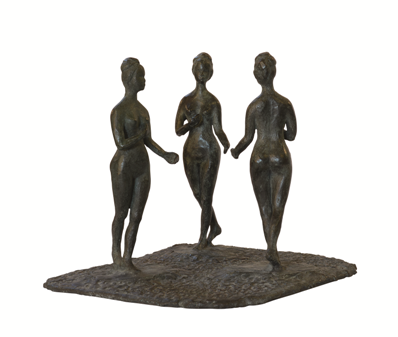 |
2002 Bronze 24 x 26 x 27 cm |
In Greek mythology, the reference shows three Graces who represented the characteristics of ideal womanhood: Aglaea (splendor), Euphrosyne (joy) and Thalia (festivity). By several other accounts however, including the famed poet Homer, there were more than three graces, perhaps explained by groups of three graces over several generations, or a collective of three at any one time to present a larger family of graces. Whatever their origin, in classical art, examples abound in both sculpture and painting: where three female figures, usually of the same likeness, are portrayed in a composition. They stand or sometimes sit, or are linked by an activity like a circular dance. The powerful ritual undertone of three women in a circle, the numerical posture of three like a pyramid – these influence how we read the narrative of the three Graces – who are the minor goddesses of what is ideal in a woman. In this small sculpture, Anna presents three figures of the same likeness, each moving toward the other and sealing their harmony within a circle. The effect is one of music; eternity and transition – we think of the elements and characteristics that form this celebration of coming of age – and how this is not simply confined to womanhood but to the cycle of life in its birth, maturation, death and rebirth over generations and centuries. |